
 CURRENT EDITION

UK guide · Safety & player rights
Helping someone with gambling while looking after yourself
Someone else gambling can affect your money, trust, sleep and sense of security. You can offer support without becoming their therapist, their permanent account monitor or the person responsible for making recovery happen. Help is available for you too.
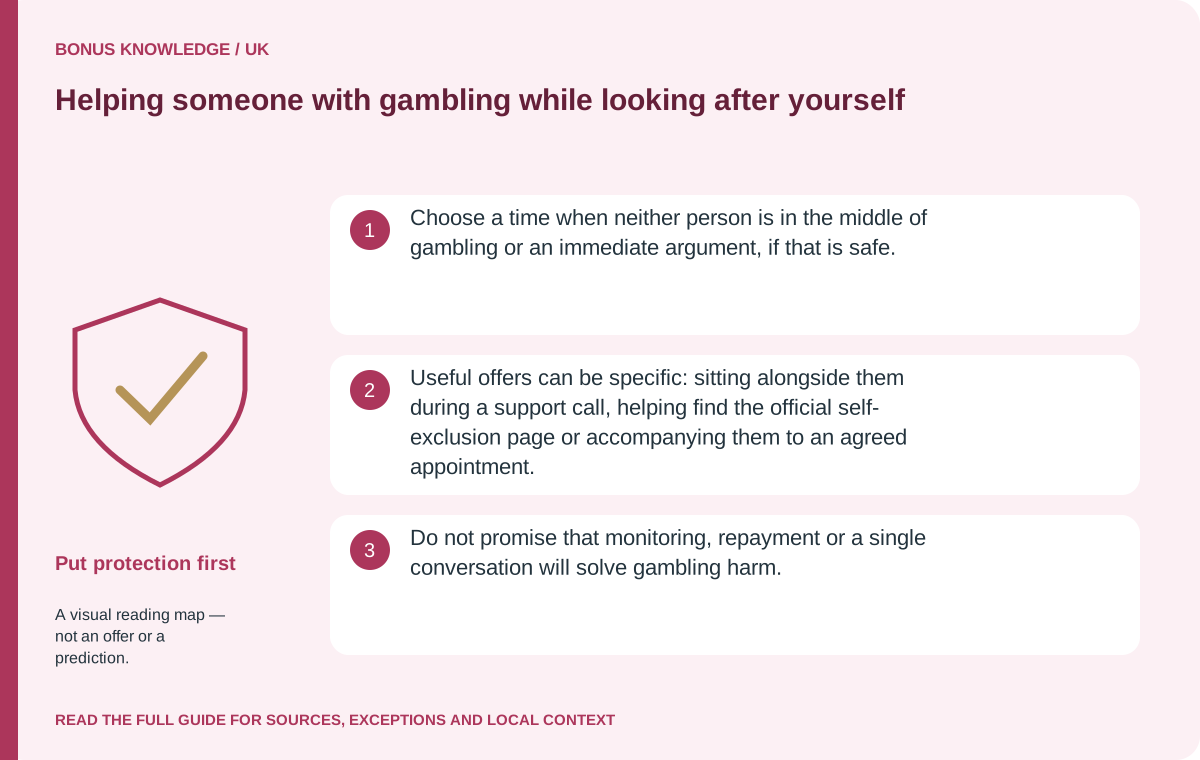
- Describe specific effects and offer a manageable next step.
- Your safety, money and wellbeing deserve independent support.
- Do not promise that monitoring, repayment or a single conversation will solve gambling harm.
Prepare a conversation around what you have noticed
Choose a time when neither person is in the middle of gambling or an immediate argument, if that is safe. Begin with concrete observations and their effect: a missed household payment, repeated borrowing or worry about sleep. Avoid presenting a diagnosis or demanding agreement with a label before the conversation can continue.
A possible opening is: I am worried because the rent payment was missed, and I want us to get advice about what happens next. Ask whether they would be willing to contact a support service with you present. Listen to their response, but keep the practical concern visible. One conversation does not have to resolve the entire history.
Offer help that has a clear shape
Useful offers can be specific: sitting alongside them during a support call, helping find the official self-exclusion page or accompanying them to an agreed appointment. Ask what assistance they want and what the service requires. Do not impersonate them, secretly access accounts or take over banking credentials.
If they want help with gambling barriers, agree who will complete each step and retain the relevant confirmation. A supporter can help organise the process, but no family member can guarantee that every barrier will work. If the person declines help, you can still contact a service about the effect on you and the choices available to you.
Treat financial pressure as a separate problem
Requests for money can be difficult when you care about the person. Before lending, paying debts or signing anything, consider your own essential commitments and get independent money advice where needed. Another payment does not establish that the gambling issue has been addressed. Avoid agreeing to repayment plans based on future gambling wins.
For shared accounts, liabilities or household bills, ask the bank or a qualified adviser about the actual arrangements and options. Do not assume you are legally responsible for every debt simply because you are related, or assume you have no responsibility where an agreement is shared. Those questions depend on the documents and circumstances. Keep passwords private and use authorised processes for any agreed account help.
Protect your wellbeing and safety
You are allowed to need rest, privacy and support of your own. Write down what you can realistically offer and what you cannot take on. If a conversation becomes threatening or controlling, prioritise safety and seek specialist help rather than trying to complete a gambling discussion. In immediate danger, contact emergency services.
Avoid making constant surveillance the only plan. Monitoring every transaction can consume your life while still leaving uncertainty. A support professional can help you consider boundaries that fit your situation. Keep children and other dependants needs in view, and seek appropriate safeguarding advice if their welfare is affected. You do not have to wait for the person gambling to accept treatment before asking for advice yourself.
Find support for affected others
GamCare support finder explicitly includes people affected by someone else gambling. It lists 0808 8020 133 as free and available 24/7. Its online support information also describes peer-support options. Tell the service whether you are seeking help for yourself, support with a conversation or information for the person gambling.
The NHS information page includes help for family and friends, but particular services have their own eligibility, location and referral rules. Ask directly rather than assuming an England clinic serves every UK resident. GamCare money guidance can also help affected others with budgeting questions. Linking to these services does not mean this website provides treatment or speaks on their behalf.
Common questions
Can I get help if the person will not stop gambling?
Yes. Services for affected others can discuss the impact on you independently of the other person decision. You do not need their participation to ask about your own support.
Should I promise to keep everything secret?
Avoid a promise that could prevent you seeking support or responding to a safety concern. Explain that you will respect privacy while getting appropriate advice for your own wellbeing and any immediate risk.
Your next useful step
- Find a support contact
Choose a contact route, check its coverage, and ask about suitable local help.
- How to stop gambling: practical first steps and support
Start with one manageable action without needing to finish a promotion.
- Gambling blocks and self-exclusion: what each tool covers
Understand what access restrictions cover and where they leave gaps.
- First-step support guide
Read the contact options and practical first-step plan together.
Sources & further reading
Read the source alongside the explanation. Rules and published terms can change; check the current official position where you live.
- GamCare: Find confidential support
- GamCare: Online and peer support
- GamCare: Money guidance for affected people
- Citizens Advice: Worried about someone gambling
- NHS: Help for problems with gambling
How this topic changes across borders
These links open the relevant local explanation. Where there is no direct equivalent, they lead to that region’s topic library.
USHelping someone affected by gambling while protecting your boundaries →EUHelping someone with gambling while protecting your own wellbeing →