
 CURRENT EDITION

UK edition · Rules, worked cards & common mistakes
Poker hand rankings: high hands, kickers and ties
Compare poker hands from straight flush to high card with a worked kicker example, wheel rules, split pots and notes on different lowball rankings.
Learn with a physical deck and no money at stake. Knowing the rules does not establish legal permission to gamble.
- Players
- Reference for poker players
- Deck
- Standard 52-card deck; no wild cards
- Goal
- Compare five-card high hands, break ties correctly, and recognise when another ranking system applies.
This reference explains ordinary five-card high poker. It is a comparison guide, not a separate betting game. Use the construction rules of the game you are playing before applying these rankings: Hold'em permits any five available cards, while Omaha demands exactly two private and three board cards. Lowball, short deck, and wild-card games can change the result.
Play a practice round, step by step
- Select a legal five-card hand under the current game's construction rule.
- Identify its category, from straight flush down to high card.
- If categories match, compare the defining ranks first and any required kickers afterward.
- If all five relevant ranks match, split the eligible pot. Do not invent a sixth-card or suit tiebreaker.
- Before the next deal, confirm that the table is still using standard high rankings rather than a low or short-deck system.
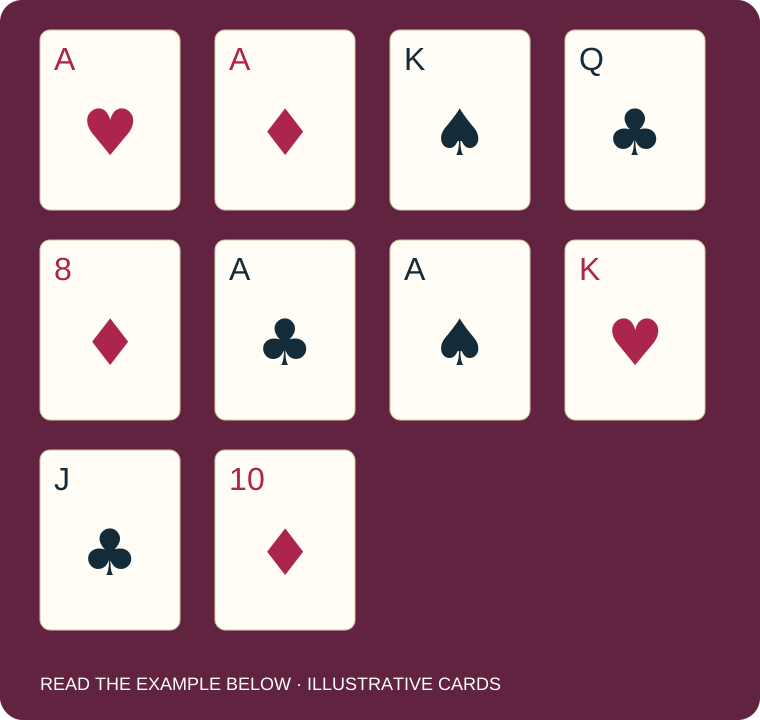
Both players have one pair of aces and a king as the highest kicker. The next comparison is queen versus jack, so the first hand wins. The losing hand's ten is never reached, even though it exceeds the winner's eight. This is not an addition contest: totals do not decide. If the first hand's queen became a jack and its eight became a ten, the two five-card rank patterns would tie despite their different suits. The ten displayed cards here are physically distinct and represent two separate hands.
The order, strongest first
Straight flush: five consecutive cards in one suit. Four of a kind: four matching ranks. Full house: three matching ranks plus a pair. Flush: five of one suit. Straight: five consecutive ranks. Three of a kind: three matching ranks. Two pair: two separate pairs. One pair: one matching pair. High card: none of these combinations.
A royal flush is simply the highest straight flush, ten through ace in one suit. In ordinary high poker an ace may finish A-2-3-4-5 or 10-J-Q-K-A. The wheel is five-high, not ace-high; K-A-2-3-4 is not a straight.
Which ranks actually decide
Compare the repeated rank first for pairs, trips, or quads. For a full house compare the trips, then the pair. With two pair compare the higher pair, lower pair, then kicker. Compare flushes and high-card hands from highest downward. Straights compare their top rank.
A kicker is an otherwise unmatched card needed to complete the five-card comparison. It matters only after the main combination ties. Suits have no showdown hierarchy. When eligible hands tie exactly, divide their pot; an agreed odd-chip procedure handles any remainder.
A comparison drill
Write two hands in five boxes rather than listing only 'pair of aces'. Circle the repeated cards, then compare the uncircled cards in descending order. Stop at the first difference. Now remove both private cards and ask whether a shared board already supplies the entire hand; in Hold'em that can make private kickers irrelevant.
Do not generalise this chart to every page in the catalogue. Razz uses ace-to-five low; deuce-to-seven penalises straights and flushes; Badugi compares usable card counts; the selected short-deck version promotes flushes over full houses. The game's name determines which comparison method belongs at the table.
Common misunderstandings
- A royal flush is the top straight flush, not a separate rule for payouts.
- A wheel is five-high.
- Only the selected five cards decide a high-poker tie.
Agree the variant before starting
- Wild cards require an extra ranking agreement, potentially including five of a kind.
- Short-deck and lowball charts must be checked separately.
Rules and further reading
Educational synthesis with AI assistance. Source check: not recorded. This is separate from the publication and content-update dates. No federation endorsement or professional review is claimed.
All card lessons · Check local rules · Understand bonus conditions · Independent support
Your next useful step
- How to play Texas Hold’em: rules and examples
See how a shared board combines with two private cards and best-five selection.
- How to play Five-card Draw: rules and examples
Learn replacement draws while keeping the completed hand private.
- How to play Short-deck Hold’em: rules and examples
Check how removing low ranks changes the deck and the agreed hand order.
- Card learning library
Choose a clearly named rule set and practise with a physical deck without money at stake.