
 CURRENT EDITION

UK edition · Rules, worked cards & common mistakes
How to play HORSE Mixed Poker: rules and examples
Learn the HORSE poker rotation, fixed-limit setup, high and low objectives, game transitions and an illustrated wheel comparison across variants.
Learn with a physical deck and no money at stake. Knowing the rules does not establish legal permission to gamble.
- Players
- 2–7 for this teaching format
- Deck
- 52 cards; reshuffle between hands
- Goal
- Apply the correct rules while playing Hold’em, Omaha Hi/Lo, Razz, Stud, and Stud Eight-or-Better in order.
HORSE is a scheduled mix rather than a sixth set of hand rankings. Each letter names the next game: Hold'em, Omaha eight-or-better, Razz, seven-card Stud high, and Stud eight-or-better. This guide sets up a teaching session using fixed limits throughout. Read the linked individual guides before starting; the rotation adds organisation, not permission to blend their rules.
Play a practice round, step by step
- Write the rotation H-O-R-S-E where everyone can see it. Agree the number of hands per game, the small and big betting units, blinds, antes, and bring-in.
- Play the announced Hold'em block, then Omaha Hi/Lo, using blinds and the correct community-card construction rules.
- Switch to Razz, then Stud, then Stud Eight-or-Better, using antes and bring-ins. Keep a marker showing where the flop-game button must resume.
- Advance a visible hand counter after every deal. Announce a game change before collecting forced payments or dealing cards.
- After the E block, return to H. Continue until the agreed session limit or tournament finishing condition.
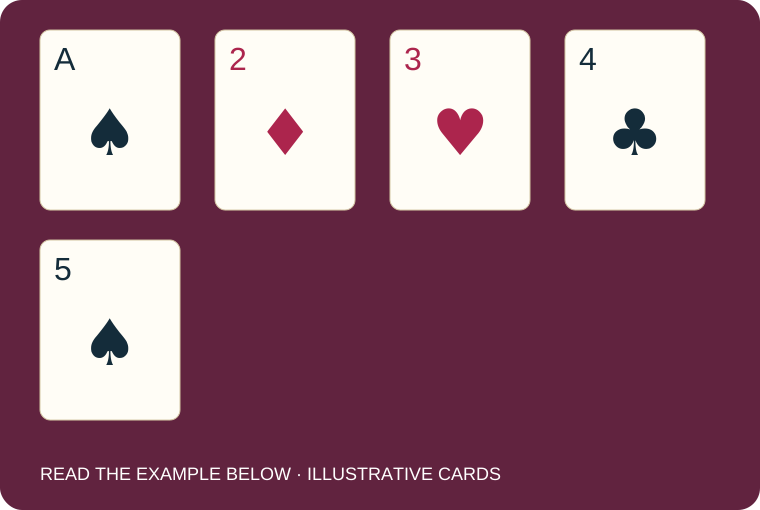
Imagine these five ranks form a legal completed hand in the active game. In Hold'em or Stud high, they make a five-high straight and can lose to a higher straight or stronger category. In Razz they are the best possible low. In either eight-or-better game they qualify for the low half and can also compete for high. In Omaha, however, you must first prove that exactly two cards came from your hand and three from the board. The illustration shows a ranking pattern, not five community cards that every Omaha player may automatically claim.
What changes between games
H and S award the pot to high. O and E split between high and a qualifying eight-low, with high taking everything if low is absent. R awards everything to the best ace-to-five low and needs no eight qualifier.
The community-card games and stud games have different action procedures. Razz's highest opening upcard brings in; the two other stud rounds use the lowest. Omaha requires two private cards and three board cards for each high or low hand. Stud allows any five of a player's seven.
A clear teaching schedule
Standard HORSE is fixed-limit throughout, not no-limit Hold'em mixed with pot-limit Omaha. For a home lesson, choose a small fixed number of hands per block and record it explicitly as your teaching schedule. Published events may instead switch after a specified orbit, hand count, or time period.
Freeze the flop-game button during the stud portion so blinds resume in the proper sequence when Hold'em returns. The stud bring-in is still determined by cards, not by that frozen marker. If a table uses a different documented transition procedure, announce it before the session.
Set out five labelled cards and move a token to the active game. Before each deal ask three short questions: high, low, or split; shared board or individual upcards; blinds or ante and bring-in. Answering them prevents most transition errors.
There is no bonus score for winning one hand in each variant. Players retain their counters across the rotation. A session winner, if wanted, follows the declared ending convention; a tournament usually continues until one player retains the chips.
Common misunderstandings
- O means Omaha Hi/Lo, not ordinary Omaha high.
- Razz has no low qualifier; O and E do.
- Do not carry no-limit betting into a standard HORSE rotation.
Agree the variant before starting
- Eight-game mix adds other games, including no-limit Hold'em and pot-limit Omaha.
- Dealer's choice permits selection under a separate agreement; HORSE has a fixed order.
Rules and further reading
Educational synthesis with AI assistance. Source check: not recorded. This is separate from the publication and content-update dates. No federation endorsement or professional review is claimed.
All card lessons · Check local rules · Understand bonus conditions · Independent support
Your next useful step
- How to play Texas Hold’em: rules and examples
See how a shared board combines with two private cards and best-five selection.
- How to play Omaha Eight-or-Better: rules and examples
Add a qualifying low half to Omaha and check when a pot is not split.
- How to play Razz: rules and examples
Test an ace-to-five low-hand system where a strong-looking high hand can be unhelpful.
- How to play Seven-card Stud: rules and examples
Follow an individual board instead of shared community cards.
- How to play Stud Eight-or-Better: rules and examples
Compare split-pot qualification with a game of individual exposed and concealed cards.