
 CURRENT EDITION

UK edition · Rules, worked cards & common mistakes
How to play Six-card Cribbage: rules and examples
Learn six-card Cribbage with the crib, pegging, fifteens, pairs, runs and show scoring, plus an illustrated twenty-nine-point hand explained step by step.
Learn with a physical deck and no money at stake. Knowing the rules does not establish legal permission to gamble.
- Players
- 2
- Deck
- 52 cards; no jokers; scoring board
- Goal
- Be the first player to reach 121 points.
Cribbage scores both the order cards are played and the combinations in the final hands. Those are separate phases with related but different rules. This lesson uses two players and six cards dealt to each. A board is convenient, but numbered paper can record a first practice game. Keep the cards from each hand identifiable until all counting is complete.
Play a practice round, step by step
- Deal six cards each. Both players discard two face down to form the dealer’s four-card crib, keeping four. The opponent cuts the remaining pack and the dealer reveals a starter; a jack starter gives the dealer two points immediately.
- The non-dealer plays first. Alternate playing cards and announcing a running total, with aces worth one and pictures ten. Never exceed thirty-one. A player unable to play says go; the other continues with any legal cards.
- Score pegging combinations as they arise: fifteen or thirty-one scores two; consecutive equal ranks score two for a pair, six for three, twelve for four. A run of at least three consecutive ranks scores its length, even if played out of rank order.
- When neither can continue, the last player scores one for last card unless that play already scored thirty-one. Reset the total; the other player starts if they have cards. Continue until all eight cards are played.
- Count the non-dealer’s hand first, dealer’s hand second, and dealer’s crib last, adding the starter to each. Alternate the deal. Stop as soon as someone reaches 121, including during pegging or a hand count.
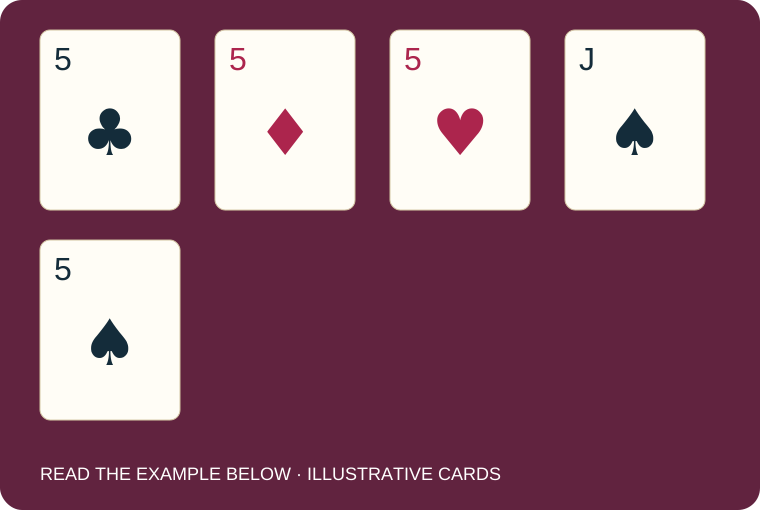
The first four cards are the hand; the final spade five is the starter. The jack pairs with each five to make four fifteens, worth eight. Any three of the four fives also make fifteen: four combinations worth another eight. Four fives contain six pairs, worth twelve. The spade jack matches the starter suit for one. The total is eight plus eight plus twelve plus one, or twenty-nine. Do not count the jack as a pair with a five merely because both can contribute to a total of fifteen. There is no run and no flush here.
Counting the show
Every distinct combination totaling fifteen scores two, every pair two, and each longest run of three or more scores its length; do not also count shorter runs contained inside it. Repeated ranks can create multiple separate longest runs. A four-card hand flush scores four and becomes five if the starter matches; a crib flush scores only when all five match. A jack in hand matching the starter’s suit scores one, commonly called nobs.
Do not merge pegging and show calculations. During pegging, combinations depend on the latest uninterrupted sequence of played cards. During the show, look across the complete four-card hand plus starter. The same physical cards can contribute in both phases because the game deliberately scores those two different situations.
A counting routine for learners
Lay out the hand with a small gap before the starter. First identify fifteens, then pairs, then runs, then flush and jack points. Say each subtotal aloud and move a token for the total only after the opponent can check it. The gap reminds you that a starter of the wrong suit does not erase a valid four-card hand flush.
For pegging practice, use a separate scrap of paper for the running total and the score. After a play changes the total from eleven to fifteen, write fifteen on the first line and add two on the score line. Resetting the running total after a go does not erase the points already earned. This distinction is particularly helpful when both players are learning the board.
Common misunderstandings
- A face card has counting value ten but retains its own rank for pairs and runs.
- The starter is not played during pegging.
- Do not count a four-card flush in the crib.
Agree the variant before starting
- Muggins penalties for missed points should be agreed separately.
- Three-player and partnership deals alter the crib procedure.
Rules and further reading
Educational synthesis with AI assistance. Source check: not recorded. This is separate from the publication and content-update dates. No federation endorsement or professional review is claimed.
All card lessons · Check local rules · Understand bonus conditions · Independent support
Your next useful step
- How to play Gin Rummy: rules and examples
Practise arranging sets and runs, then count only the unmatched cards.
- How to play Scopa: rules and examples
Try a table-capture game: matching values replaces trick-taking.
- How to play Hearts: rules and examples
Contrast winning tricks with avoiding the penalty cards contained in them.
- Card learning library
Choose a clearly named rule set and practise with a physical deck without money at stake.