
 CURRENT EDITION

UK edition · Rules, worked cards & common mistakes
How to play Contract Bridge: rules and examples
Learn Contract Bridge with auction basics, declarer and dummy, following suit and a first duplicate score, supported by an illustrated club trick.
Learn with a physical deck and no money at stake. Knowing the rules does not establish legal permission to gamble.
- Players
- 4 in two partnerships
- Deck
- 52 cards; no jokers
- Goal
- Win the number of tricks promised by the final contract.
Bridge asks partners to describe their hands through an auction, then cooperate through card play. This introductory lesson uses duplicate-style scoring for a single undoubled practice board. It teaches the sequence of a deal, not a bidding system or the complete tournament laws. Partners sit opposite; avoid private signals or comments that tell only your partner something about your hand.
Play a practice round, step by step
- Deal thirteen cards each. The dealer starts the clockwise auction. A bid names a level from one to seven and clubs, diamonds, hearts, spades or no trumps; pass is also available.
- Each new bid must outrank the last: increase the level, or use a higher denomination at that level. Denominations rise from clubs through diamonds, hearts and spades to no trumps. Three passes after a bid finish the auction; four opening passes pass out the board.
- The final bid sets the contract. Its level means tricks beyond six: three no trumps promises nine. The first player on the winning side who named the final denomination becomes declarer.
- The defender left of declarer leads. Declarer’s partner then exposes all thirteen cards as dummy, arranged by suit. Declarer chooses dummy’s plays; the partner does not independently decide them.
- Follow suit when possible. Otherwise discard or trump freely. The highest trump wins, or the highest card of the led suit if no trump appears. Each trick winner leads next, from the hand that won.
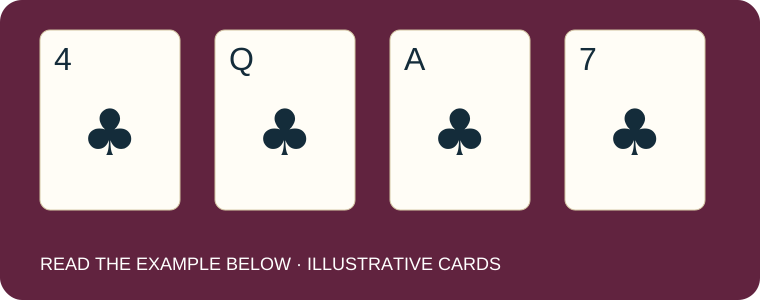
The club four is led, dummy contributes the queen, the next defender plays the ace and declarer follows with the seven. The ace wins and that defender leads next; dummy does not win simply because it played a picture card. For a separate score example, three no trumps made with exactly nine tricks earns forty plus thirty plus thirty, or one hundred trick points. Non-vulnerable, add the three-hundred game bonus for four hundred total. With only eight tricks it is down one and gives the defenders fifty. These examples assume no double and no additional scoring adjustments.
A first scoring framework
For an undoubled contract made exactly, each contracted trick beyond six scores twenty in clubs or diamonds, thirty in hearts or spades, or forty for the first no-trump trick and thirty for each later one. A contract reaching one hundred trick points earns a game bonus: three hundred non-vulnerable or five hundred vulnerable. Otherwise add fifty for a partscore.
An undoubled failed contract gives defenders fifty per undertrick when declarer is not vulnerable, or one hundred when vulnerable. Overtricks, slam bonuses, doubles and redoubles extend the calculation; use the linked scoring reference rather than extrapolating from this first lesson. Vulnerability is fixed for a duplicate board and must be known before the auction.
Keep the learning tasks separate
Use one practice deal to learn the auction without judging the quality of the bids. Write a ladder containing one club, one diamond, one heart, one spade and one no trump. Ask which calls can follow each entry. Then erase the cards and practice identifying declarer from a written auction. The person making the final bid is not always declarer.
For the next practice deal, omit scoring and concentrate on which hand must lead. Leave each completed trick aligned until everyone agrees who won it. When dummy wins, place a marker beside dummy before choosing the next card. This physical reminder prevents declarer from accidentally leading from the wrong hand. Restore ordinary hidden-hand play only after the sequence feels comfortable.
Common misunderstandings
- A level-three bid asks for nine tricks, not three.
- Dummy becomes visible after the opening lead, not during the auction.
- The winning hand leads next; declarer cannot freely switch hands.
Agree the variant before starting
- Rubber Bridge has a different cumulative scoring structure.
- A bidding system, alert obligations and tournament remedies need further study.
Rules and further reading
Educational synthesis with AI assistance. Source check: not recorded. This is separate from the publication and content-update dates. No federation endorsement or professional review is claimed.
All card lessons · Check local rules · Understand bonus conditions · Independent support
Your next useful step
- How to play Partnership Spades: rules and examples
Compare a fixed trump suit and a partnership trick-count promise.
- How to play Euchre: rules and examples
See how the two bowers change both trump ranking and following suit.
- How to play Classic Belote: rules and examples
Distinguish trump rank from captured point value in a partnership game.
- Card learning library
Choose a clearly named rule set and practise with a physical deck without money at stake.